Authors: Michelle Hauer and Kate Woloshyn
Alberta is home to many buildings that have undergone large-scale retrofits, transforming them into modern, high-performing structures with reduced energy use and emissions. Retrofitting a whole building and its many interconnected systems is complex work and is known as a “deep retrofit.”
In this blog, we highlight a selection of completed and in-progress projects in Alberta to help you explore approaches, learn from real-world experience, and get inspired by what deep retrofits can achieve.
The projects in this blog meet two main criteria:
- They considered multiple building systems. For example, they upgraded mechanical heating and cooling systems and the building exterior. We refer to this as a “whole-building approach.”
- They have publicly shared the project’s achieved or modelled energy efficiency or greenhouse gas emissions reduction. This performance is typically compared to the building’s pre-retrofit performance or to minimum code requirements.
We’ve grouped the retrofit projects by building use type and highlighted some interesting features of each.
Municipal and Institutional Retrofits
Eden Valley Arena, Bearspaw First Nation Building
The federal government has invested $1,453,632 in this project, located about 100 kilometres southwest of Calgary, through the Green and Inclusive Community Buildings (GICB) program. It will support upgrades to the electrical and HVAC systems, the building envelope and the arena ice. Once the retrofit is completed, these improvements are expected to reduce the facility’s energy consumption by an estimated 46.7% and GHG emissions by 133 tonnes annually. Learn more here.
Glenbow
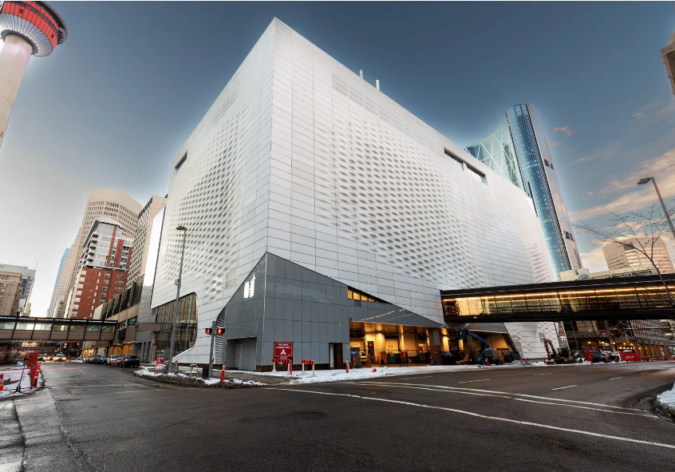
This 1970s Calgary museum is being transformed into the JR Shaw Centre for Arts & Culture, a community hub designed to foster creativity, innovation, and community. The renovations are expected to result in a 38% reduction in annual energy use and 41% reduction in annual greenhouse gas emissions. Future risks and hazards associated with climate change have also been incorporated into the project, improving the building’s resilience. Learn more here.
MacKimmie Complex Redevelopment Project
The University of Calgary underwent a deep retrofit of the MacKimmie building, reducing its energy use by 80%. Designed with high-performance features and achieving Canada Green Building Council (CaGBC) Zero Carbon Design Certification in 2020, this 355,000-sq.-ft. retrofit was one of 16 to be selected to participate in the CaGBC zero-carbon building pilot program. Learn more here, or watch this Deep Retrofit Discovery Session, hosted by Alberta Ecotrust and the Southern Alberta Institute of Technology (SAIT).
okimaw peyesew kamik (King Thunderbird Centre)
This Edmonton retrofit was completed in February 2026 and the facility now serves as Boyle Street’s main hub. It is certified under version 3 of the Zero Carbon Building – Design Standard™. This 85,000-sq.-ft. building was designed with sustainability, resilience, and operational efficiency in mind. The existing building structure was reused, and the project incorporated 360 solar photovoltaic (PV) panels, generating 206.9 MWh per year, and a geothermal system. Learn more here.
Town of Legal Arena and Curling Rink
The Town of Legal, about 40 kilometres north of Edmonton, is currently undertaking a major retrofit of its arena and curling rink with support from the Federation of Canadian Municipalities (FCM) through the Green Municipal Fund, combining a $1.25-million grant and a $3.75-million loan. The project will significantly reduce greenhouse gas emissions by upgrading the building envelope, modernizing mechanical and electrical systems, and implementing energy-efficient technologies expected to cut energy consumption by more than 30%. These improvements will lower operational costs, increase system efficiency, and transform the facility into a more sustainable, accessible, and resilient community hub capable of supporting recreation and emergency response needs while advancing local climate goals. Learn more here.
Multi-Unit Residential Building (MURB) Retrofits
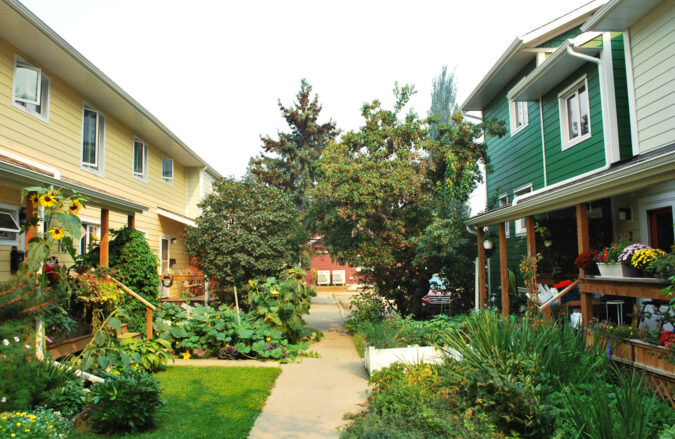
Sundance Housing Cooperative
A townhouse deep energy retrofit in Edmonton’s river valley, this project was supported by a $2.5-million federal investment from Natural Resources Canada (NRCan) through its Energy Innovation Program, alongside funding from a long-term mortgage and the cooperative’s renovation fund. This project aims to accelerate the adoption of panelized, prefabricated deep energy retrofits across North America to cut costs, reduce pollution, and maintain affordable housing. The project is a notable demonstration, aiming to make 59 of its townhouse units “net-zero ready” by installing new, energy-efficient exterior wall panels that are fabricated off-site and installed directly over existing walls. “Ultimately, this reduced their energy needs by 70-80%, and eliminated the need for gas lines in the original 59 units.” Learn more here.
The SunRise Building
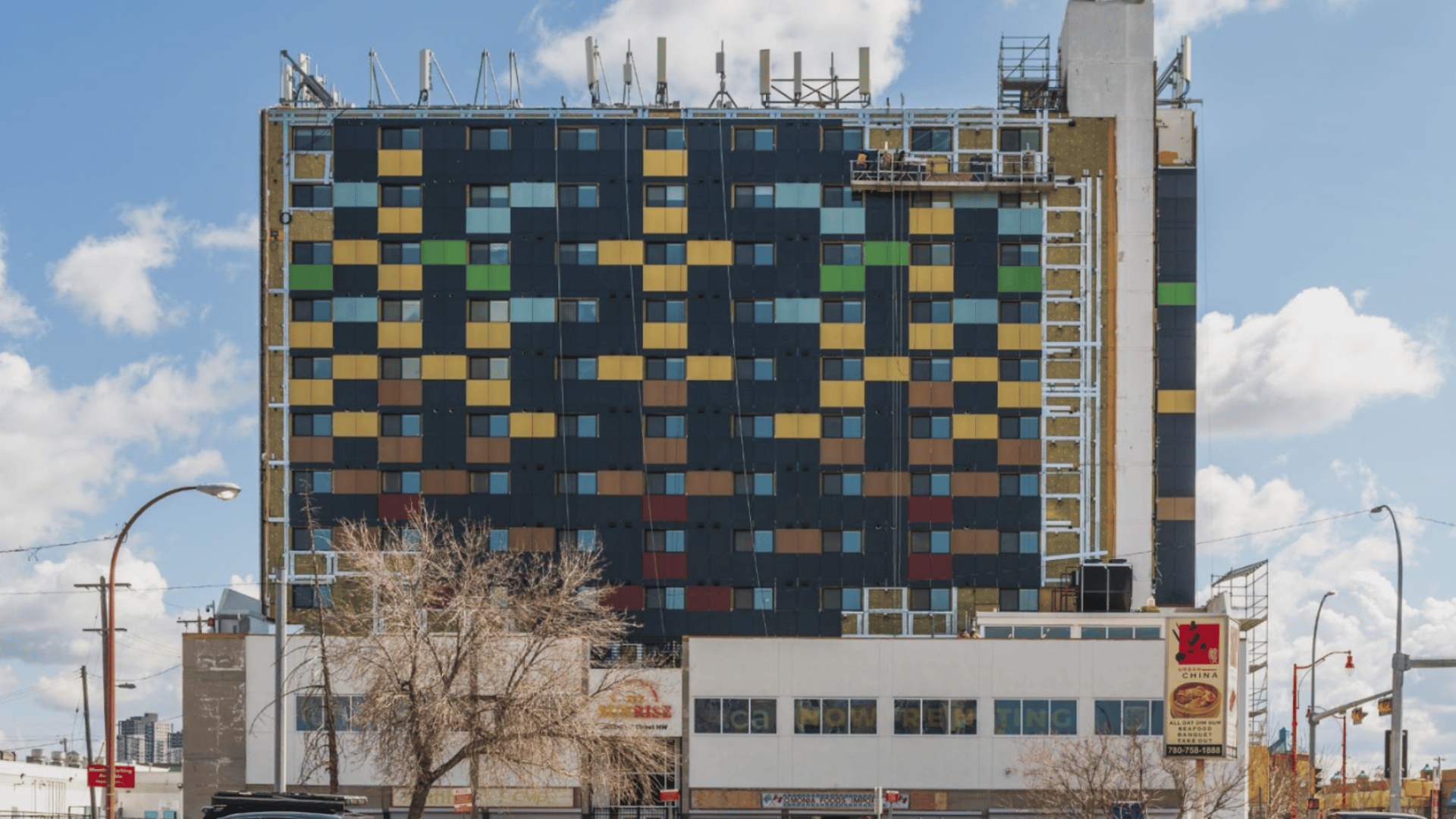
This Edmonton building recently completed a challenging deep-energy retrofit, targeting 64% reductions in GHG emissions to create sustainable, affordable housing. A case study (recorded at Buildex Alberta 2025) detailed the project’s inception, decarbonization strategy, financing, construction, and modelled energy savings, GHG emissions reductions, and embodied carbon. Learn more here.
Tennyson Apartments
The company owning these apartments in Edmonton took advantage of the Canada Mortgage and Housing Corporation’s (CMHC) MLI Select Program. The project included upgrades to roof insulation, installation of variable speed pumps, implementation of an HVAC optimization program, low-flow plumbing fixtures, new domestic hot water heaters, and the addition of solar photovoltaic (PV) modules. Projections estimate that the building will consume 32% less energy and reduce GHG emissions by 33%. Learn more here.
Office to Residential Conversions
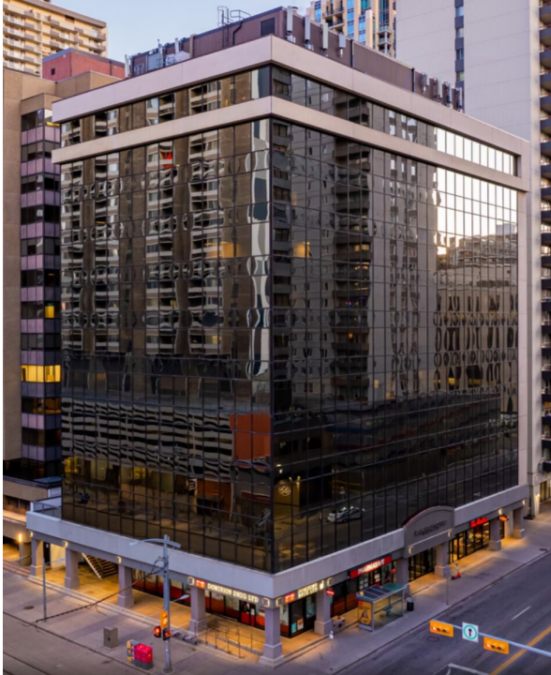
Dominion Centre
A downtown Calgary office-to-residential retrofit, this project is supported by the City of Calgary’s Downtown Retrofit Challenge and the Downtown Calgary Development Incentive Program. These projects aim to revitalize downtown Calgary by addressing office vacancies and housing demand. The Dominion Centre project is a notable success, with a projected Energy Use Intensity (EUI) 29% better than the BenchmarkYYC Average for Multifamily Residential Buildings (2021) at the 99% design stage. The new residential building is modelled to use 51% less energy and produce 40% fewer GHG emissions compared to the original office building. Learn more here.
Petro Fina Building
This building in downtown Calgary was designated as a Municipal Historic Resource by Calgary City Council in 2023 and is adjacent to the new University of Calgary downtown campus. Its deep retrofit transformation was completed in 2025. The building now has 103 units, including accessible units and units at below-market rates. The Petro Fina Building lent itself well to an office-to-residential conversion thanks to its layout, which could be reconfigured into residential units, most of which are 2- and 3-bedroom apartments. The renovations include a full replacement of the mechanical systems and the installation of more energy-efficient windows. The building’s energy performance is expected to be 25% better than minimum energy code requirements. Learn more here.
Office Retrofits
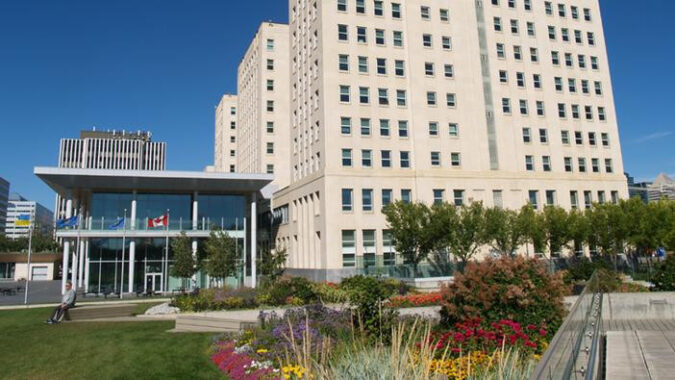
Queen Elizabeth II Building (formerly the Federal Building)
This provincial building in Edmonton sat vacant for two decades. From 2010 to 2015, it underwent an extensive retrofit, earning Leadership in Energy and Environmental Design (LEED) Gold certification. This rating indicates that the building uses 40 to 50% less energy and produces fewer GHG emissions than a standard building. Key to this upgrade was modernizing the mechanical and electrical systems to significantly boost energy efficiency. Learn more here.
WSP Place
This downtown Edmonton building, owned by ProCura Real Estate Services, completed its transformation in 2016. Renovations included high-performance windows and framing, a significant increase in insulation, and a renovated mechanical system. Solar panels were also added to the rooftop. The building is reported to use an impressive 40% less energy thanks to this major retrofit project. Learn more here.
Honourable Mentions
The projects in this section haven’t publicly shared their energy or GHG reductions, but stood out during our research for other reasons, highlighted below.
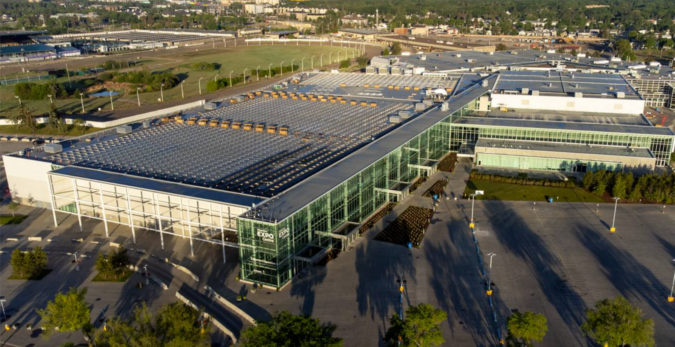
Edmonton Expo Centre
As one of the City of Edmonton’s largest and most energy-intensive facilities, the Edmonton Expo Centre (522,000 square feet) underwent a multi-phase retrofit to improve its energy performance and support the City’s emissions-neutral goals. The project maximized the value of the existing building while upgrading major systems, using an integrated project delivery (IPD) approach to ensure cost efficiency, accelerated timelines, and optimized performance. The team maintained an inclusive culture onsite, which included everyone from contractors to architects, and used scenario planning to move beyond traditional “like-for-like” replacements, aligning design and implementation decisions with long-term carbon-reduction goals.
The facility also features a 5 MW rooftop solar array, the largest in Canada. The Expo Centre was designed to eventually connect to a clean district energy system, allowing for a phased approach. This is a strong example of a deep retrofit strategy that prioritizes long-term impact. While it may not achieve the highest savings immediately, the retrofit enables significant future emissions reductions as additional systems are integrated over time.
Learn more here, or watch Alberta Ecotrust’s Deep Retrofit Discovery Session to learn more.
Hi-Tech Seals Warehouse
This commercial warehouse in Edmonton is zero-carbon, meaning it has no gas meter. This impressive achievement for a commercial building was made possible in part by major energy-efficiency upgrades and the installation of a ground source heat pump system in 2006. Further upgrades in 2023 completed the full electrification of the building, and a rooftop solar photovoltaic (PV) system was added to supply renewable energy to the building. Learn more about the technical details of these upgrades from this Deep Retrofit Discovery Session.
Did we miss a project?
We are constantly learning about new deep retrofits in Alberta and would love to hear from you if you know of one not on this list. Contact buildings@albertaecotrust.com to tell us about your project!
Acknowledgements
This list was created by Alberta Ecotrust and key industry partners: the Green Building Technology Access Centre at the Southern Alberta Institute of Technology (SAIT), the Alberta Energy Efficiency Alliance (AEEA), and the Pembina Institute.
Stay tuned for more!
The Pembina Institute is partnering with Alberta Ecotrust on a study exploring some of Alberta’s deep retrofit projects in much more depth than we’ve shared here. If you’d like to learn more about how this complex work happens, sign up for the Pembina Institute’s Buildings program email list to be notified about their upcoming Surfacing Conditions report.